

ATVNetwork
-
Posts
588 -
Joined
-
Last visited
-
Days Won
17
Content Type
Profiles
Forum
Gallery
ATV Magazine
Events Calendar
Downloads
Store
Community Map
Everything posted by ATVNetwork
-
 View full post
 -
For the third year in a row, Jagged X and the No. 1919 Polaris Ranger RZR S dominated Best in the Desert's "Vegas to Reno, The Long Way" race. The No. 1919 desert race team not only finished but... More...
-
Polaris Ranger RZR S drivers Mark Holz and Doug Eichner picked up two class wins and finished one-two in the overall at WORCS Round 6 at Straddleline ORV Park, in Olympia, Wash."Holz and Eichner ha... More...
-
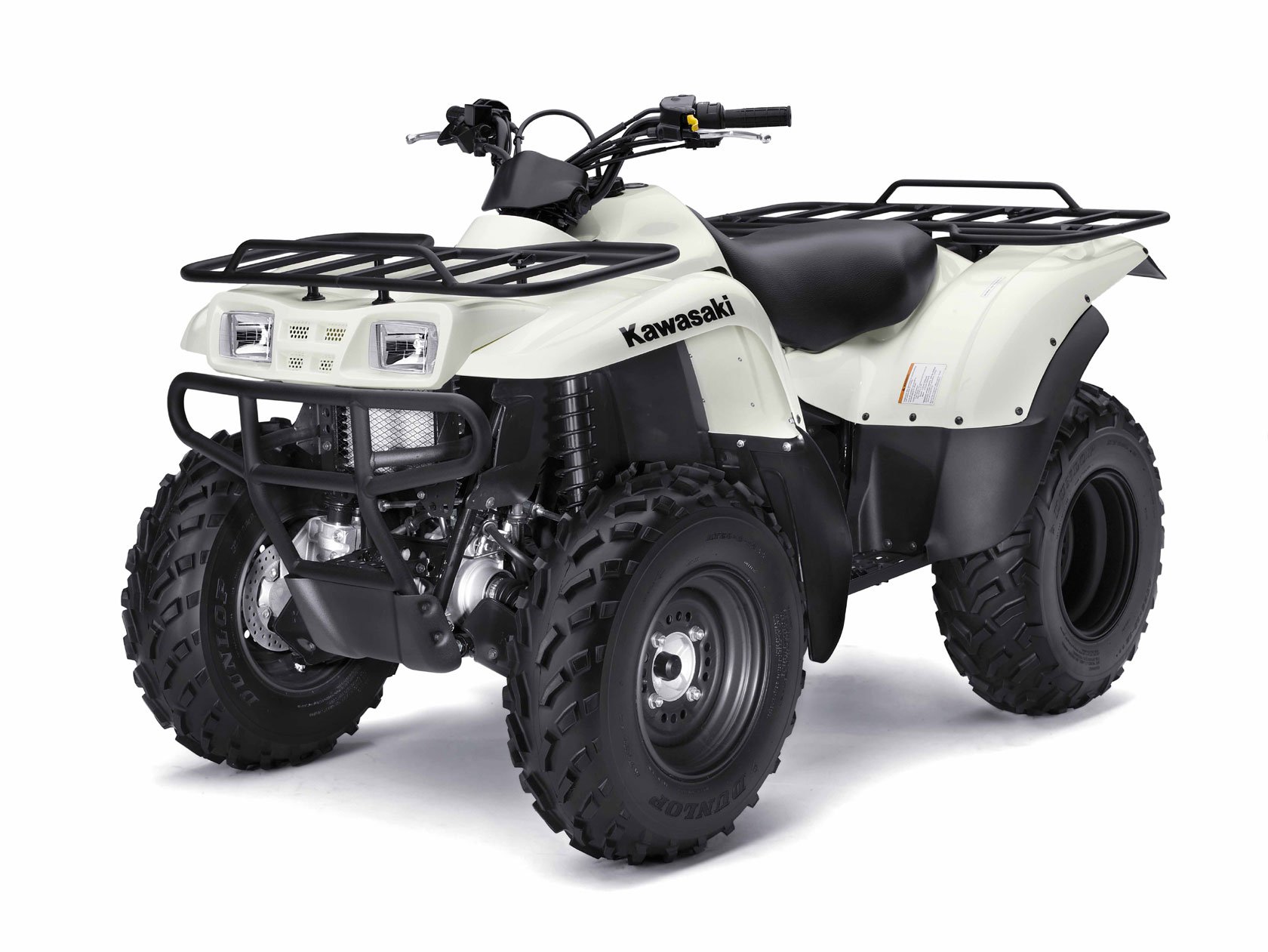 It may not be the biggest and baddest thing on four wheels, but there is something very appealing about the Kawasaki Prairie 360 4x4. We had the opportunity to put some miles on Kawasaki’s smallest 4x4 and it proved to be an eye-opening experience. We tested out the Prairie, along with the Brute Force 650 and 750 4x4i, at the Mines & Meadows ATV/RV Resort in Western Pennsylvania. Shockingly, it was the little Prairie that stood out most among the big bore offerings from Team Green. Kawasaki’s proven 362cc air-cooled, single cylinder, 4-stroke engine powers the Prairie. Though it’s never going to snap your neck back when you the squeeze the throttle, the Prairie accelerates smoothly and has an impressive amount of low-end grunt for this class. More impressive is the class-leading 1,100-pound towing capacity. Kawasaki’s entry-level 4x4 surprised us with its ability to keep up with the big boys. What helps the Prairie make the most of every last bit of its power is an advanced four-wheel drive system – available at the push of a button. If you just want to fly around the trails and let the rear wheels drift around the corners, you can keep it in two-wheel drive. However, if you want to tackle more challenging terrain or need to add some traction if you’re working around your property just switch it over to four-wheel drive mode and you’re ready to go. Just squeeze the yellow diff-lock lever for as much or as little extra traction as you require. Kicking it up another notch is the limited-slip front differential, which keeps the steering reasonably light. When the situation calls for maximum traction a Kawasaki feature we really like is the variable front differential control. You access this very progressive system by squeezing a lever on the left handlebar just above the brake lever. When you need full traction and are worried less about steering just squeeze the lever all the way. If you require some additional traction but need more steering control just squeeze the lever about half way. We can’t say enough about how much we like this differential control system. Other ATVs have easier to use push-button diff locks, but this one really makes you feel like you have that extra bit of control. The combination of four-wheel drive and the variable front differential control combine to make the Prairie a go-anywhere ATV. You don’t often think of a 360cc ATV being an adept climber, but the Prairie proved otherwise. The best example of the Prairie’s climbing prowess we can come up with occurred when we were trying to scale a steep, rocky hill on a big Brute Force 650. As we were taking our time looking for the right line, somebody from Kawasaki flew up the course on the Prairie to show us the way. We’re no great rock climbers and surely a more adept rider could have made short work of that hill, but to see the Prairie 360 4x4 climb over everything we were struggling with on the Brute Force made us appreciate what it could do. The Prairie 360 4x4 will go just about anywhere you’d need it to. Even with it’s go-anywhere personality, some of you who are used to riding big 800cc machines will probably be left wanting more power and top speed, but that’s not who this ATV is made for. The Prairie 360 4x4 is an ideal ATV for somebody new to the sport and because it’s such a good all around quad we don’t think it’s something you’d grow out of for quite some time. Stability is very good thanks in part to the Prairie’s 47.4-inch width – 1.5 inches wider than the Brute Force 750. That wide footprint gives you confidence as soon as you throw a leg over the seat. It seems lighter and more flickable that the bigger Brute Force, but the specs tell a different story. Both units weigh in at about 605 pounds dry. That’s a lot of weight for lower-displacement ATV, but it was hard to feel it during our test. Getting the rear wheels to slide around a corner is no problem. Helping to cushion your ride is a MacPherson strut front suspension with 6.7 inches of travel. You’ll find more modern front suspension systems (independent double A-arms), but MacPherson struts have a proven track record and offer a smooth ride. All the way through 2008 that’s all Polaris used on its Sportsman line of utility ATVs – some of the best selling and best performing in the business. Also, because MacPherson struts have been around for a while using them keeps costs down. One possible bone of contention with the Prairie is the rear swingarm with a single adjustable shock. Having fully independent rear suspension would be beneficial, but the straight axle is not a bad option for new riders. It’s easier to hold a line in a whooped-out section of trail and you can attack corners more aggressively. You do lose a little ground clearance – the Prairie has 7.7-inches of clearance at the rear axle – but try finding a trail you can’t tackle with the Prairie that you could with an IRS equipped unit. Stopping power comes courtesy of dual disc brakes up front and Kawasaki’s very effective sealed, oil-bathed multi-disc system in the back. Kawasaki uses that sealed rear brake system on just about every vehicle in its lineup and it’s great at keeping mud, dust, water, and other debris away from your brakes. There’s practically no maintenance with this system, which means you can ride more and spend less time in the garage. Engine braking is also standard and it’s a great tool for helping you slow down in a steep descent – you don’t have to be as precise with the brake levers so you can concentrate more on steering. Use the engine braking to help slow you down on a descent. Prairie owners get some additional utility from the standard front and rear cargo racks that can carry a combined weight of 242 pounds. You can strap down more than enough gear for a camping trip or you could haul just about anything around your property. At $5,349 the Prairie 360 4x4 is right near the bottom of the price scale for this class from major manufacturers. It comes in $50 less than the Yamaha Grizzly 350 4x4, $150 less than the Suzuki KingQuad 400 AS, and $350 less than the Polaris Sportsman 400 H.O. You can get the Prairie without the 4x4 option for $550 less ($4,799), but we think it’s worth spending the extra cash on four-wheel drive. If you’re looking to break into the utility ATV segment, you should definitely put the Prairie 360 4x4 on your short list. Even if you’re not a beginner, the Prairie would be a fun addition to your garage – especially as a utility companion to a sport quad. You won’t win any races against the big boys, but you’ll have a lot more money in your wallet. Kawasaki Prairie 360 4x4 Specifications Engine Engine Type: Air-cooled, SOHC, four-stroke, single cylinder Displacement: 362cc Bore x stroke: 80 x 72mm Compression Ratio: 8.3:1 Carburetion: Keihin CVK34 Starting System: Electric with recoil back up Transmission: Continuously variable transmission with Kawasaki Engine Brake Control, high and low range, plus reverse Final Drive: Selectable four-wheel drive with Variable Front Differential Control, shaft Dimensions Overall Length: 81.3 in Overall Width: 47.4 in Curb Weight: 639.5 lbs Wheelbase: 49.3 in Seat Height: 35.6 in Ground Clearance: 7.7 in Fuel Capacity: 3.6 gal Rack Capacity Front / Rear: 88 / 154 lbs Towing Capacity: 1,100 lbs Chassis Frame: Double cradle steel Front Suspension / Wheel Travel: MacPherson strut / 6.7 in. Rear Suspension / Wheel Travel: Swingarm with single shock, preload adjustment / 7.1 in. Front Brakes: Dual hydraulic discs Rear Brakes: Sealed, oil-bathed, multi-disc Front Tires: AT25x8-12 tubeless Rear Tires: AT25x10-12 tubeless Footpegs: Adjustable Other Lighting: 30W x 2 halogen Colors: Woodsman Green, Sunbeam Red and Polar White MSRP: $5,349
 -
View full post
-
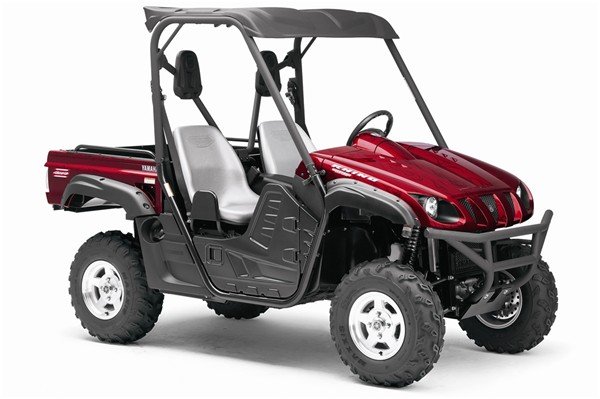 It’s been three months since Yamaha launched a free repair program for all Rhino models which included adding one-inch spacers on each of the rear wheels and removing the rear anti-sway bar. To prove that these repairs did nothing to take away from the Rhino’s off-road capability, we were invited to the San Bernardino Forest in southern California to test out the 2009 Yamaha Rhino 700 FI Sport Edition for ourselves. Oftentimes when a manufacturer invites the media out to test drive a new vehicle we don’t end up getting a great deal of seat time as we’re focused on getting pictures and talking to the people who helped design it. Also, because they don’t want to put us or their expensive machines in harm’s way manufacturers sometimes avoid the gnarliest terrain. To Yamaha’s credit, this was absolutely not the case this time. We were led on a near 80-mile trek that had our adrenaline pumping and at times tested our resolve. We beat the holy hell out of our Rhino 700 to see exactly what it was capable of. At the end of our ride our bodies ached and we were completely exhausted, but we came away wholly impressed. WHY THE CHANGES The vast majority of responsible Rhino owners, enthusiasts and most everybody associated with the popular side-by-sides that we talk to really didn’t feel like adding the spacers and removing the anti-sway bar was a necessity. If you ride the Rhino like you’re supposed to, your chance of tipping over and injuring yourself is not particularly high – certainly not noticeably higher than other sporty side-by-sides. Of course, we don’t always ride off-road vehicles like we’re supposed to, do we? "If you ride the Rhino like you’re supposed to, your chance of tipping over and injuring yourself is not particularly high..." We’ll get more in depth on this in a future article, but suffice it to say a small percentage (Yamaha says far less than 1 percent) of Rhino customers were involved in rollovers with serious consequences. It didn’t take long for plaintiff attorneys to take notice and start looking for money/clients in every way possible (billboards, Google ads, television commercials) and tried to get the Consumer Product Safety Commission (CPSC) to issue a recall. After looking at a number of accident reports the CPSC (much to the chagrin of the plaintiff attorneys) couldn’t find anything that warranted a recall. In fact, in nearly all the cases the CPSC looked in which somebody was killed (96%) the victim either wasn’t wearing a helmet or was doing at least one warned against act (no seatbelt, driving on paved road, driving under the influence, no driver’s license, too young, too small, etc.). The CPSC, in cooperation with Yamaha, did decide to issue a free repair program for the Rhino 450 and 660 and Yamaha included the Rhino 700 on its own. The CPSC believes these modifications “may help reduce the chance of rollover and improve vehicle handling in certain situations.” Still a Rhino Yamaha’s ultimate goal for inviting us to ride its modified side-by-side was to show us that it is still a Rhino. Yamaha didn’t want the changes to turn the Rhino into something else – either closer to a competitor’s unit or just plain less capable. After almost 80 miles of rocks, roots, water and dirt we can indeed assure you that this Rhino is still, well, a Rhino. The Rhino is powered by a 686cc liquid cooled, fuel injected engine. We spent our day riding between 5,000 and 7,500 feet above sea level and didn’t have a hint of trouble. Because of the lower levels of oxygen at that altitude you will lose some power, but for the trial riding we were doing it was not particularly noticeable. Throttle response was instant and felt nice and torquey in the low end. That low-end power came in very handy throughout the day, especially when we were led over the toughest rock crawling section we’ve ever attempted in a side-by-side. We're far from true rock crawling aficionados, but fortunately Yamaha Testing Supervisor Pat Bilosi was there to show us the right lines. From the driver’s seat some of these lines were concerning, but with a little faith, four-wheel drive, a fully locked differential and a press of the gas we got over everything without incident. We wouldn’t try it again on our own, but pushing the Rhino to the edge and coming through with a rapid heartbeat and big smile was an experience to remember. Not every trail was as butterfly-inducing as the rock crawling section, so we did get a few chances to pin the pedal and burn up some quicker trails. While four-wheel drive offers a little more confidence in the rough stuff, we prefer two-wheel drive for fast trail riding. It really frees up the back end to slide around corners and kick up some dust. Yamaha has a speed limiter on the Rhino 700 models set at about 40 mph. If you’re riding around tight, wooded trails or getting some work done on your property this is more than enough speed. However, for wide open desert riding or other high-speed applications this might be somewhat limiting. No need to fear, though, as a visit to a forum like Rhinotalk.net will help you find a solution or lead you to any number of aftermarket companies that can help you uncork your Rhino in a heartbeat. It’s obvious the engine has a lot more speed to give, but Yamaha has the limiter on for a reason – the faster you go the more likely you are to get into trouble. If you decide to uncork your Rhino you’re doing so at your own risk. Comfort, Safety & Other Features After such a long, grueling day it’s safe to say the Rhino provides a reasonably comfortable ride. The seat provides good support and we didn’t suffer from “numb butt” at any point. Our only gripe is the seat belt would dig into our shoulder, but that may have been the result of aggressive driving. Still, one day we’d like to see somebody offer a four or five-point harness on a “Sport” specific unit. Doors come standard on Rhino 700 models and they come in handy. They help keep your feet from sliding out and trail debris from getting in. Yamaha offers a free door program for any Rhino that didn’t come with them from the factory so if you’ve got an older model you should take advantage. A digital instrument panel with multi-function LCD display provides everything you need, including an easy to read fuel gauge, speedometer and duel trip meters. Though it’s not nearly as fun as being behind the wheel, we did spend some time in the passenger seat to get a different perspective. So long as you’ve got a driver you trust, being a passenger is pretty relaxing. The center-mounted passenger handhold might be our favorite outside of the T-shaped bar on the Polaris Ranger RZR. Sport Package Our Sport Edition proved to be an awesome trail riding companion. The fully adjustable piggyback shocks were great for hammering through rocky, rutted out trails at high speed and crawling over huge rocks at a much slower pace. Despite taking a great deal of abuse, the one-piece cast aluminum wheels were certainly up to the challenge. Though we started out taking care to hit rocks head on and avoid any unnecessary damage, as the day progressed we were far less vigilant and started shredding through rocky fields with reckless abandon. The wheels and tires did not make it through the entire ride completely unscathed, but we can’t think of any product that would. The Sport Edition also includes an injected-molded sun top, which was ideal for keeping the hot July sun off our necks. Also, a Baja-inspired front carry bar, red water-dipped body, dealer-installed LED tail lights, steering wheel cover, custom shift knob, over fenders, and black bed rails help set the Sport Edition apart. One thing we’d add to the Rhino Sport Edition and every other Rhino is a more durable skid plate/underbody protection. This is not a big issue for desert riders, but for those of you who like tighter, more technical trails this is important. Admittedly we really put an abnormal pounding on our test unit, but the plastic skid plate didn’t last long. GYTR manufactures a number of protection items that would make a world of difference, including a Baja Front Bash Plate ($150.95) that would be perfect for the Sport Edition. Aftermarket companies like DG Performance sell similar products that would no doubt help keep your Rhino safe, especially in conditions like we encountered. Conclusion It may not be as sporty as the Polaris Ranger RSR S, as fast as the Arctic Cat Prowler 1000 H2 XTZ, or possess the utility of a Kawasaki Mule, but the Yamaha Rhino 700 FI Sport Edition is among the most versatile side-by-sides available. The Rhino was the first of its kind and it’s still a force to be reckoned with.
 -
View full post
-
Jagged X picked up the 2009 Best in the Desert Series where they left off in 2008, taking first at the Epic Products Parker 250 for their sixth consecutive win.The No. 1919 Polaris Ranger RZR started... More...
-
Yoshimura R&D of America has developed a brand new exhaust system for the Polaris Ranger RZR.The RZR is the sportiest of the side-by-side vehicles and Yoshimura's new RS-8 muffler is designed t... More...