-
ATV Forum Leaderboard & Trending ATV Discussions
Welcome to the QUADCRAZY ATV community leaderboard featuring the most active ATV forum members, trending ATV discussions, popular repair topics, and top-rated ATV content from across the community.
Explore ATV troubleshooting, maintenance tips, Polaris repair discussions, Honda ATV topics, Can-Am forums, Yamaha ATV discussions, ATV accessories, mud riding setups, trail riding advice, and more from fellow riders.
🔥 Trending ATV Discussions
🛠 Popular ATV Topics & Tags
Browse popular ATV discussions covering ATV winches, mud tires, snow plows, batteries, helmets, maintenance, oil changes, repairs, upgrades, and trail riding setups from riders across the QUADCRAZY community.
🏁 Popular ATV Forum Categories
About the QUADCRAZY ATV Community
QUADCRAZY is one of the largest ATV forums online featuring ATV repair help, trail riding discussions, ATV modifications, buying advice, maintenance tutorials, and off-road community discussions covering Polaris, Honda, Yamaha, Suzuki, Kawasaki, Arctic Cat, Can-Am, and more.
Leaderboard


Popular Content
Showing content with the highest reputation on 03/28/2023 in all areas
-
They are quite soft, and can bend.. As long as we are gentle we should be able to bend them straight again.. Heat would help but then it's hard to handle and work. I think I might heat it and let it cool as slowly as possible, cover it with hot ashes would be good.. That would soften the metal to it's softest natural condition, called normalizing. Then I'd use a one pound hammer on an anvil. The trick is telling when it's right again.. Have you figured that out ? Might have to take the other side out and use that to compare as a mirror image..1 point
-
Well first off, when you were checking the earths and saw a small voltage, how much voltage was it ? If it was a half a volt it's too much really. You need to find the bad earth connection. With a bad earth it's possible that when you spin the engine over by hand you might see a spark at the plug, and if you spin it over with the starter and the plug out the earth might be god enough to allow cranking and a small spark, but when the plug's in, and the starter's working hard, that bad earth could be enough to prevent the coil working properly. The air gap is preset and isn't likely to be your problem. All you need to check is that the trigger/pulse coil has the correct resistance, and that it puts out a small voltage when the engine is spinning over. It probably only puts out about one volt, and it only does it once per revolution and it's very brief. Most digital gauges won't pick that brief voltage up. It's best to use an old fashioned analogue gauge with a needle. You will see the needle jump. It won't be readable but as long as it jumps then you know the magnet or trigger plate on the rotor is attached and doing it's job. Even when the trigger coil has the right resistance, and should work fine, they won't do anything if the trigger plate has fallen off the rotor, or if there is a flake of rust or a small collection of metal dust accumulated on the trigger coil's core. A single flake of rust, if it bridges the gap between the core and the rotor is enough to short out the magnetic field and prevent the trigger from happening. You need to check the trigger coils resistance to be sure it doesn't have a break or short, and you also need to test it's putting out some small amount of voltage to be sure there's nothing mechanical, like a flake of rust, stopping it working.1 point
-
BWhen you touch the 2 posts together you are bypassing everything and sending battery voltage directly to the starter , if you have 12 v going to the relay when you push the button the relay closes and you get 12v to the starter soloenoid one with 2 big post and then to starter if it’s good and your wires going from the start button or switch are good .1 point
-
Atv, I posted a wiring diagram for the model with an eight wire cdi, did you see that ? If you connect the black wire with a white stripe (described as "Bl"), which comes from the cdi, to any black wire, it will kill the ignition.1 point
-
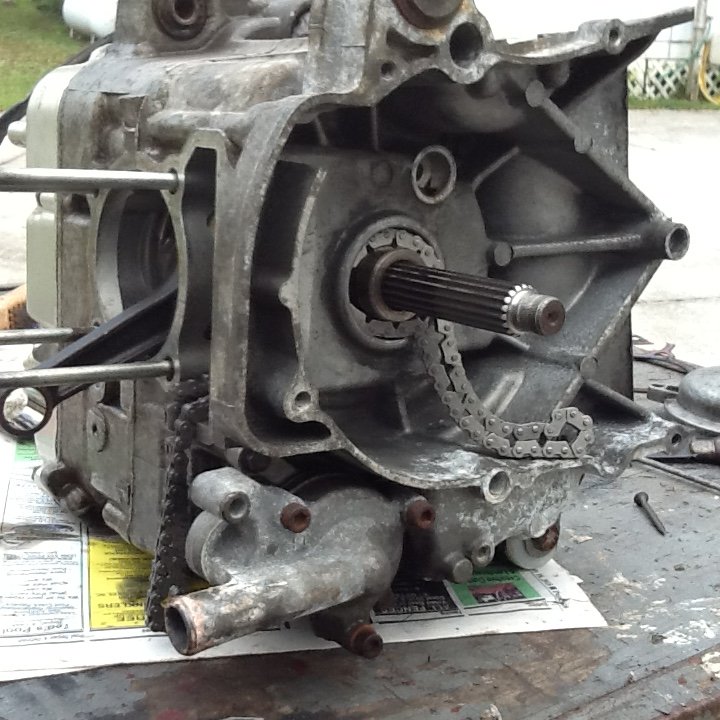
Hi I'm new here , nice forum. I have aquired a XY 300, that seems to be the same as a Linhai of the same model. I was gifted the machine in poor condition, with a locked engine due to broken cam chain, and a broken front strut shock. I have replaced cam chain and have the ute running well now. My need is information about the spacers used to mate the engine to the transmission, alignment of variator and clutch. A blueprint of the alignment jig used in the manual would be ideal. Thanks S
 1 point
 -
According to the wiring diagram the black wires all go to earth, including the ones from the kill and main switches. When the switches are closed/turned to off, they connect the black earth wire to a wire that's black with a white stripe, to earth, and that kills the ignition. The black with white stripe comes from the cdi.1 point
-
Are you getting 12v and ground to the small wires on the solenoid.1 point
-
Well given it\s so intermittent I'd be suspecting a wiring problem. I'd be checking for good power supply to the ignition unit and the coil, and that they both had good earths. Since it got turned off and started again until you started to move it, I'd assume a wire just needs to move very slightly to loose power. Up around the steering head where the wires move a lot is a place they chafe through the insulation, and the other place where wires nearly always break is right at the end where they go into their metal terminal. They often break inside the insulation, and a bit of a wriggle sometimes makes they contact again, or, you feel the wire bends too easily because it's only the plastic holding it together.1 point
-
You are right Mule, those are not a cdi, they are just like an old fashioned points and coil ignition system except the points have been replaced by a transistor and the ignition timing is calculated and adjusted in the ignition unit. The coil and ignition unit both run off the battery.1 point