


davefrombc
-
Posts
1,192 -
Joined
-
Last visited
-
Days Won
216
Content Type
Profiles
Forum
Gallery
ATV Magazine
Events Calendar
Downloads
Store
Community Map
Everything posted by davefrombc
-
Winches come in very handy at times.. mine has rescued others a couple of times and myself once. I would have just wired in the winch relay box properly.
-

That one bolt that just won't let go
davefrombc replied to Ant-Knee's topic in General Talk - Anything Goes!
Get help from a friend to heat the frame evenly over the area the steel tube is in while you try to work the steel post back and forth. Heating the aluminum should make it expand slightly before the heat transfers to the steel ,giving you a little wiggle room to get it to break loose. -
The Official Good morning thread!
davefrombc replied to BuckBilly's topic in General Talk - Anything Goes!
A very big NOPE ! for me.. LOL. Loved flying but never could understand jumping out of a perfectly good plane or off of high places. -
Have a very safe and Happy Thanksgiving to all the Canadian members on here
-
Why Weize ATV Batteries Are a Top Choice
davefrombc replied to quadcrazy's topic in New ATV Products, Reviews & Tests
Had a little basis in fact years ago when battery cases were not made of the plastics used today. But even then leakage through the old battery cases was very small compared to the internal leakage inherent in lead acid batteries. -
Why Weize ATV Batteries Are a Top Choice
davefrombc replied to quadcrazy's topic in New ATV Products, Reviews & Tests
Lead acid ATV / UTV batteries, whether AGM, SLA or flooded are like car batteries.. They will last years longer if kept on a maintainer when not in use. Letting them sit at less than full charge is the biggest killer of them due to sulfation build up. -
Yes you can do that .It's just the longer the arm is from the receiver the more torque has to be overcome.Unless there is a need to have the rack up level with the rear rack I think the shorter height is better, but that is just personal preference.
-
Tool rack level can be at top of tire height up to level of the original Foreman rack. The higher the tool rack, the more torque is exerted on the assembly from sideways rocking movement as you're traveling.
-
Sounds like a good plan. With the rack extending so far behind the rear wheels even with the 6" lift it'll likely only be good on relatively flat ground. though
-
I would use 2" square tubing to come out from the receiver and for the upright to the receiver at top for the rack. An angle brace from the horizontal to the upright and on to to the receiver would be good too.. You could use soft attachment at top to help stabilize the rack side movement.
-
I would suggest a little welding project. Build a hitch extension similar to a bike rack.. Come out from the receiver, up to a desired height ( I would say just above rear tire height) and attach a receiver there.. You could mount your tool rack there.. It would keep it high so it doesn't hit the ground when negotiating the dips and humps in a trail . Mounted at receiver height extends the rack so far behind the rear wheels it would drag on going through or over any but the smallest dips and bumps.
-
You can install mirrors on the handle bars a la bicycles., but if you want a camera you should be able to fabricate mounts front and rear. I don't know of any that would be stabilized enough to make a camera nearly as effective for rear view on the move as mirrors would be.
-
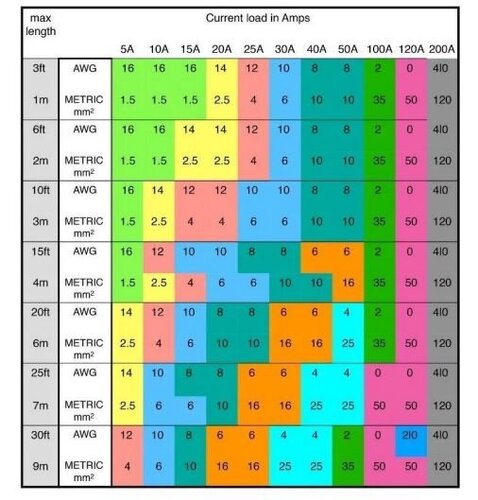
9 downloads
pdf chart How to calculate the right size wire: Step 1: Determine the current rating (i.e. amps) for every appliance you expect to use in your campervan. Some appliances will state their rating as watts rather than amps. For 12 volt components like your fridge, campervan lights and USB phone charger for example the calculation is: Amps = Watts / 12 volts (if running a 24 volt system then divide it by 24.) Step 2: Determine the length of the longest circuit you plan to install. To do this, measure the total distance you’ll lay your cable from the battery to the appliance and back to the battery again. Step 3: For a quick estimate to determine the exact minimum wire gauge needed, use the table below. Choose the maximum cable length on the left based on your measurements in step 2 above, and the amps based on the highest number calculated in step 1 above. -
Use 12 gauge , even 14 would do.. 10 gauge is way overkill. Your choice whether to run ground wire back to the battery or ground to frame.. Either would work, but my preference is to run both wires from battery to socket. There is a wire chart in the download section showing capacity of the different gauges and wire lengths.. I generally use heavier gauges than those shown for my wiring to be sure to minimize voltage drop over distance.
-
The accessory socket ( cigarette plug) connector is available in vehicles and power stations so the fridge/ freezer can easily be used between vehicles and power stations. They work very well for low current accessories. You'll find them on all the portables. They are by far the most practical for low draw accessories like portable fridge freezers. For custom connections for high draw uses I use the various sizes of Anderson connectors because, unlike SAE connectors they cannot be cross connected
-
I'll likely see lots of argument , but I'd choose the least expensive offering of a 12v fridge / freezer in the size you want.. Nearly all of them are made in China or elsewhere in Asia and the same box can have all sorts of names tacked on it ,along with prices from low to ridiculous "No Name" to " Luxury Name". All the fridge / freezers are compressor types, and heavier than a similar sized electronic cooler only. I like my Vevor, Mike likes his similar machine . I suggest searching on " 12v fridge / freezer" to see the online offerings from the various vendors. Choose the size you want and price you're willing to pay, after checking on the units specs. Vevor offers ones from 10 quart mini' up. The myriad of offerings are made by various companies and have the Vevor name badge on them. Find one you like, compare it to other hits you see with different names on them and make your choice. Just a side note .. My unit listed at $298 CAD is the same capacity as a friends unit with a "name brand" that cost over $1,000 CAD bought at a brick and mortar store. Here is a link to the myriad offerings at Vevor.com ( USA site) Check their offerings and others and compare https://www.vevor.com/s/car-refrigerator-cooler
-
There may be other US sites with as good or better deals, but I got my 12v fridge / freezer from Vevor on their Canadian site . Mine came with a 12v power cord to run the fridge and a 120V ac to 12v dc power supply to run the fridge off house current. Here is the link to the Canadian site. https://www.vevor.ca/s/58-qt.-cooler-,-freezer
-
I have a 12v cooler / freezer I run on my power box.. It is compressor type, not thermo-electric and can be set from about 40F to -4 . Things like larger 120v ac motor driven tools, appliances` ,and microwave ovens can draw up to 3 and 4x their rated power so most can only be run by the most powerful power stations of at least 2000w. Lights and resistive loads like lights,a coffee pot or electric kettle will work on 1000w power stations as long as their rated power is 1,000w or less.. Technically resistive loads draw their rated power on start while inductive and capacitive loads can draw 3 times or more thah their rated power on start up.
-
I'm one of those who at 82 their minds still think we're 28 ( same numbers, different order) but body says "like hell you are" ! It's the old story.. I can still do most of the things I did back then . It just takes me longer, I need more help and I hurt a lot more afterwards!
-
Yes the SAE connectors are fine, just a gotcha for the unwary. You won't need to increase the wire size.if you used at least 14 gauge wire. 14 gauge will handle up to 15A. . When using the 200w solar panel the panel is not likely to output more than 10 t0 12 amps under even absolutely ideal conditions.. Boost the fuse to 15A if using a 200w solar panel to input but the 7.5A might be enough for the 100w one. To be sure with the 100w panel go to a `10A fuse. Is your 12v fridge piezoelectric or a fridge/freezer one that uses a 12v compressor?.. My 12v 50L fridge/freezer pulls between 4 and 5A on start but runs at around 1.8A. If your fridge drew the 3.5A steady over 24 hours it would deplete the 100Ah battery ( pull just over 1000Wh out of the 1280Wh battery)
-
I am not a great fan of the SAE 2 pin connectors for the simple reason they can be reverse connected. By convention the power end ( connected to a battery) has the positive side covered and the negative exposed. The accessory o be powered has the exposed positive and the negative covered.. But in the case of a battery charger, they are reversed with positive exposed and the negative covered.. It is too easy to err when putting connectors on a project and the unwary can make all the smoke leak out by misconnecting things.. That's the beauty of Anderson connectors. They are polarized so they can only connect positive to positive and negative to negative . That is as long as they are wired correctly to start with.. The MC4 connectors are almost universal on solar panels and cables because they are waterproof ( actually water resistant) but they share the accidental reverse connecting problem of the SAEs
-
It would be helpful at times to have a button where we could cont the Admin. to make some changes to our posts.
- 1 reply
-
- 1
-

-
OK.. The panel likely has the MC4 "waterproof" connectors . I just did a search on Amazon for solar controllers and came up with this one among all the others. It looks like it would be ideal for you if your solar panels have MC4 connectors . I suspect the cable from the solar panels you have aren't MC4 on both ends so you would need to replace it since that controller is only MC4 input. Here is the controller I found on Amazon https://www.amazon.com/Charge-Controller-Type-C-LiFePO₄-Battery/dp/B0DGP8YMGD/ref=sxin_18_pa_sp_search_thematic_sspa?content-id=amzn1.sym.5a2f80d8-3686-499a-bbaa-70664bd0de70%3Aamzn1.sym.5a2f80d8-3686-499a-bbaa-70664bd0de70&crid=1GCIO4YGOLTNF&cv_ct_cx=MPPT+solar+controller&keywords=MPPT+solar+controller&pd_rd_i=B0DGP8YMGD&pd_rd_r=fd470b51-a005-4e0a-bebd-3e00107e5b72&pd_rd_w=hv9Zg&pd_rd_wg=VKAcc&pf_rd_p=5a2f80d8-3686-499a-bbaa-70664bd0de70&pf_rd_r=2J7MHQA0QB01JV4E6G1J&qid=1758461740&sbo=RZvfv%2F%2FHxDF%2BO5021pAnSA%3D%3D&sprefix=mppt+solar+controller%2Caps%2C171&sr=1-2-6024b2a3-78e4-4fed-8fed-e1613be3bcce-spons&sp_csd=d2lkZ2V0TmFtZT1zcF9zZWFyY2hfdGhlbWF0aWM&psc=1
-
What output connections does your cable from your folding panel use? Mc4, 5521 barrel, or XT60? Most solar controllers have a socket to connect a 5521 input and you can get adapters to go from whatever the cable end is to the inputs of the controller .. You can make a quick connect pair to connect your controller to the battery Store the controller, cable and controller to battery adapter with the solar panel.. That way you don't need to permanently mount the controller to your trailer. With a portable setup like that you could make an adapter to go from the controller output to alligator clips so you could use your portable solar setup to charge any 12 or 24V .battery since most new controllers are programmable for 12 / 24 volt output to any lead acid or LiFePO4 battery. You would just have to re3member if you were going to charge a battery type different than your trailer one.
-
If your tent trailer is a hard top you could mount your solar panel (s) to it. LiFePO4 batteries have different charging profiles than both lead acid and Li ion ones. I don't know anyone who keeps their LiFePO4 batteries on a tender (maintainer) so I can't really offer an opinion on that.. Your use of the LiFePO4 battery is entirely different than mine. I built my Power Station ( Power box) to be a portable source of 1000w / 110v pure sine wave AC, and 12v DC from either a 12v accessory socket or up to 100 A output to run an electric trolling motor and 12v power tools. Commercial Power stations I am aware of don't offer the high amperage 12v output to go with their AC and 10 to 15 A the give at their accessory socket. That was the re4ason for my initial question .. T see if others have or use a Power Station ( power box) in their outdoor activities, whether it be out on the trails with an ATV , in camp or out on their boat.