

davefrombc
-
Posts
1,192 -
Joined
-
Last visited
-
Days Won
216
Content Type
Profiles
Forum
Gallery
ATV Magazine
Events Calendar
Downloads
Store
Community Map
Everything posted by davefrombc
-
1996 Polaris xPlorer 300 Kill Switch Problem
davefrombc replied to frugalsob's topic in Polaris ATV Forum
Your quad likely uses a magneto ignition. Those are killed / turned off by grounding the ignition, If you are looking for continuity when On and no continuity when Off you have it backwards.. When the kill switch is in the run position there should be no continuity through it , and in the kill position there should be continuity. It's just the opposite of a points and condenser or electronic system. -
Rod knock is usually, but not always, a duller sound than detonation ping. It is easier to tell in a multi-cylinder vehicle like car than in single or twin cylinder ones in ATVs. A loose rod or wrist pin can knock either under load, when backing off or if fairly bad even when idling but normally detonation only occurs under load. When it is happening in car, it is often described as "marbles" rattling around in the cylinders . Detonation is hard on everything and if not taken care of by backing off the timing advance a bit or by going to higher grade fuel can result in holes hammered or burnt into the pistons.
-
Detonation is just that. The fuel mixture exploding in the cylinder instead of a rapid (VERY RAPID) burning in the cylinder. It can be caused by ignition too far advanced or by use of fuel too low a grade for the compression ratio / cylinder pressures. When everything is right, the fuel actually burns rapidly as the piston descends on the power stroke. When detonation because of over advance causing cylinder pressure to increase far over normal or fuel grade is too low the fuel instantly burns (detonates) rather than burning continuously during the power stroke. The rattling noises you hear with many diesels when idling are actually mini- detonations with the high compression and very lean diesel mixture.
-
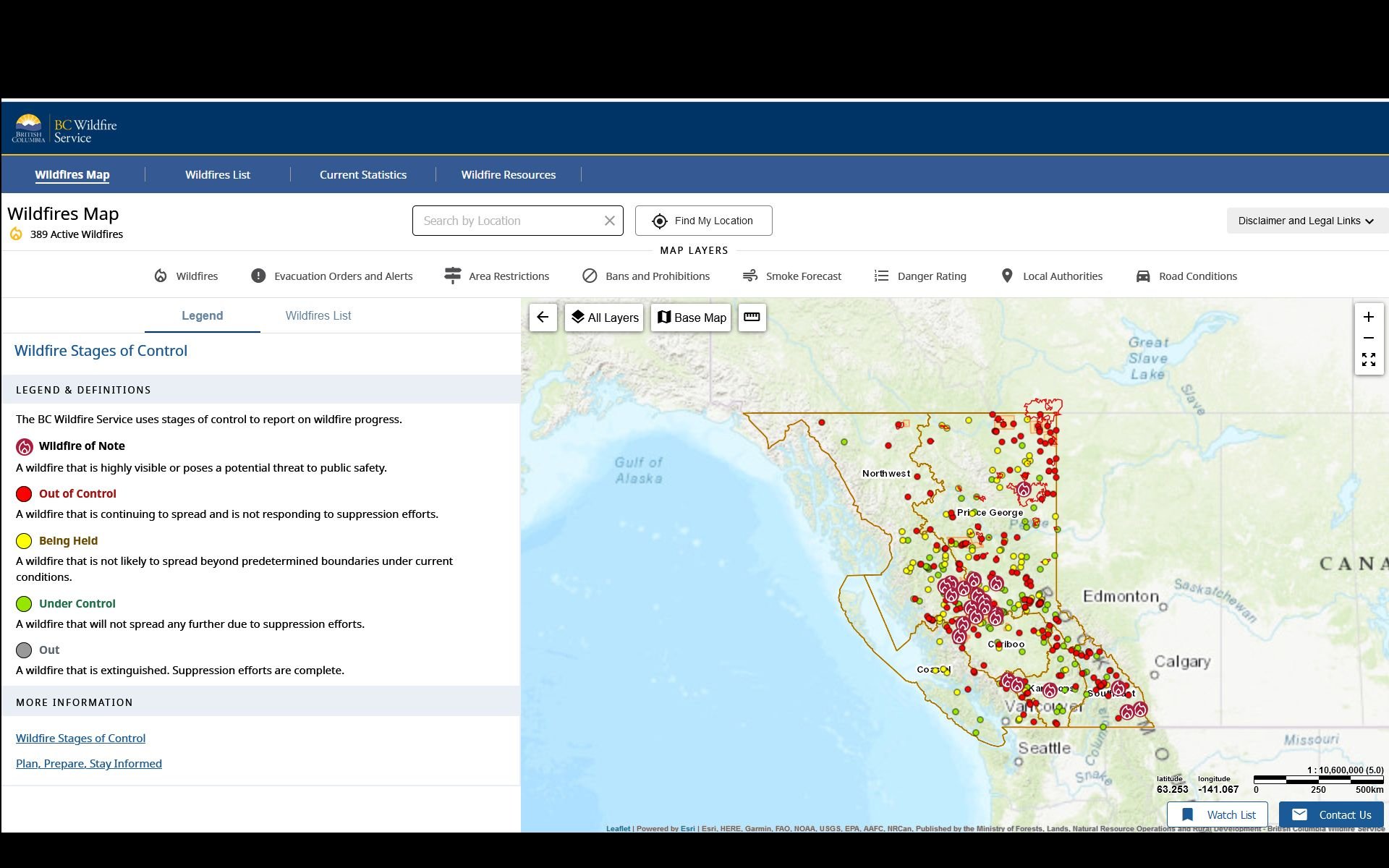
Heat wave and drought has been brutal with no end in sight yet, but I've been surviving it. At least I haven't had to put in the 2 hours every week bouncing on my riding lawn mower instead of the quad. We haven't had a total of an inch of rain since the beginning of June, and August is normally our driest month, so there likely won't be any mowing needed until next spring. Down side is the bush is so dry and there's so many fires going riding isn't a very good idea. Here's a map of the fire situation in BC now. For perspective, the province of BC is 3.5 times larger than New Zealand.

-
Knocking noise was most likely detonation from the over advanced condition as Mech mentioned.
-
Try going directly from the battery to the starter to see if it turns over .. The brushes in the starter could be worn and commutator dirty. They may not making contact all the time. Also check for loose, corroded connections. there might be a break in a wire that is not obvious too. That would allow the broken ends to make and break with movement of the wire during use and movement. To keep batteries from sulphating up when the quad is idle for longer periods, use a battery maintainer.. Sulphate build up from a battery sitting at less than full charge causes the battery to lose capacity until eventually it fails completely or shorts a cell. Sorry I can't help more than giving those suggestions .
-
If it comes to needing drilling for an "easy out" use a left twist drill. Often the bit will spin the bolt out when it bites into it. As mentioned before , use some heat on it and let it cool before using penetrating oil. The heat would kill the locktite if it was used, and by letting it cool before using penetrating oil, you won't end up hardening it so a drill bit won't bite.
-
I am saying if valves and seats look like that drawing after lapping the idiot that did it should seek other work. "Multi-angle" valve jobs like shown would only be used on extreme performance engines. Normal multi-angle valve jobs are 3 angle; and with more and more manufacturers going to aluminum heads, valve seats are replaceable. Cast iron heads may have induction hardened valve seats but if they are cracked or badly worn and the head is to be kept, they are machined for replaceable seats. If you send your heads out to be serviced, ask the shop if they lap the valves whether the seats are integral or replaceable; and how many angles they use in performance head valve servicing.
-
I'll leave the reply to the comments you made to the op to others. I don't think the moderators would allow me to say what I think of them and the valve pix you added. LOL...
-
I'm interested in knowing just for what machine that service manual is. Those pictures show some pretty bad valves, but what I see there , they appear to be more likely the wrong valves used in some applications and in some of them some very serious overlapping. Lapping new or ground valves to an undamaged seat or recut one shouldn't result in wear on the valve of more than a few microns; not enough to remove any hard surface if the valve was only case hardened rather than through hardened. Those pictures do not show valve failures from any proper lapping.
-
Mike Nixon makes a lot of noise about Neway cutters in his motorcycle babble. I'd listen to the manufacturers and mechanics that recommend valve lapping as a part of a "valve job".. Just the opinion of another that spent his working life in the mechanical trades . Listen to GW and Mech.
-
Have a safe and very MERRY CHRISTMAS everyone..
-
2003 Kodiak Leaking fuel from drain hose at bottom of carb
davefrombc replied to DPDISXR4Ti's topic in Yamaha ATV Forum
You either have an air leak somewhere between the carb and intake port, the mixture settings on the lean side or , most likely, either the high speed needle in the wrong notch or there is a tiny hole in the side of the brass tube the main jet needle slides through. Those tiny holes are often missed when people are cleaning the carbs -
A good maintainer will not boil a battery out. They're a far cry from the old ferro-resonant trickle chargers. Flooded batteries are not good in ATVs. They leak because of the bouncing they get from ATV service, and AGM batteries are needlessly expensive. A SLA battery doesn't leak in ATV service and in my opinion is by far the best choice for price and ATV reliability. Yes you can top up a battery every few weeks or at most every 3 to 6 months in storage , but then you must remember to do it, bring them to full charge and then remember to disconnect them from the old trickle chargers. The newer maintainers can be connected and left connected without worrying about boiling them out or having them go flat and sulfate up because you forgot to top them up.
-
Walmart Canada has batteries that fit most ATVs.. I'm sure they do in the US also. Amazon also lists a range of ATV batteries. Just search on one for your ride. Costco likely does too. Look at the user ratings they list and the number of people who commented and rated to see the average star rating. As I said earlier in the thread, most of the batteries, whether they are a big name brand or a generic perform about the same; and all need to be kept on a maintainer when the ATV is idle for any length of time. Get an SLA battery. . The cheaper flooded ones can leak with the shaking they get from ATV use.. The AGM ones are more for use where they may be mounted in a non-upright position and are needlessly expensive. The SLA are leakproof, and maintenance free beyond keeping them charged up . Beyond that I cannot tell you which battery brand is the "Best" one. You'll find nearly all ATV and utility batteries have a short warranty period compared to automotive ones. The main reasons are the environment they are used in and so many do not keep them charged up when not in use, like the ride -on lawnmower parked and forgotten at the end of the season and expected to start and run next spring for example. Get one well rated by other buyers, and the best price to you, Keep it charged up with a maintainer and you should get years of service out of it. It took a friend of mine several battery replacements before he took the advice to buy a good maintainer for his seasonally used boat battery. Buying one good maintainer is a lot better and cheaper in the long run than buying several batteries because they keep "Failing"
-
I doubt there is much use fro lithium batteries for starter batteries in vehicles since weight is not really a problem there and lead acid batteries serve the job very well. The LiFePo batteries are seeing increasing use in RVs and other storage applications where large capacity in a smaller, lighter weight package is desirable. The biggest factor limiting their adoption so far is their price. The vehicle fires from lithium batteries were mainly from the earlier lithium ion batteries, not the newer LiFePo ones. I don't know the safety data on the newer ones. Off grid systems pose a lot of different considerations from RV ones. The charge controllers available now for solar/ wind/ micro hydro systems are a lot more reliable and failsafe than those in use a few years ago. They really shouldn't be a determining factor. Initial cost is likely still the biggest determining factor in newer installations although according to the industry the lithium should far outlast the lead acid ones. I don't think there is enough long term data on that count to see if there is any real long term savings to lithium. I do know the short days and weak winter sun along with snow mean systems that rely on solar and wind power need a lot more storage capacity and draw down survivability than in areas where short days and snow are not a factor.-
-
What Winch To Buy?
davefrombc replied to rockwell16's topic in This vs. That ATV & Off Road Comparisons
Dirt is the big enemy of the synthetic lines because of the abrasion it can cause between the fibers of the rope/ tape. I don't know anyone using synthetic lines but there's enough information on them online for anyone who cares to research them before deciding whether it is to their advantage to go that route or not. Randy , be glad you've never experienced the destruction a recoiling cable can cause. The line doesn't have to fail to do it . The point it is attached to is more often the projectile, but the line itself can sever a limb or worse if it catches a victim in recoil. There are enough pictures of what can happen when pulling a stuck vehicle by the hitch ball on the net for example . There's a lot more to winching and vehicle recovery than just hooking a line to something that looks solid and pulling. -
Lithium ion batteries are prone to fires if overcharged. shorted or if they get wet. LiFePo are much less prone to fires. Lithium fires CAN be put out, but like phosphorus and sodium fires, you can't use water to do it .. It takes foam or dry chemicals and lastly Lithium batteries can be recycled. Yes, lithium mining is dirty, but so is mining for any mineral/ metal. All mining causes environmental damage in the mined area and too often downstream of the mine when environmental protection practices are absent or inadequate. Lead pollution is a far bigger problem than lithium use poses. Lithium battery technology has improved a lot since the first ones were introduced, and very likely more can be done with them. There are also stories of development of other "exotic" battery technology in the works.. With all that being said, in my opinion SLA batteries are still the best choice for our fossil fueled mobile toys when price, capacity and performance are all taken into account. Keep them charged and on a maintainer when they are idle and you will get long service life out of them . Let them sit flat or idle for a long time and they will deteriorate rapidly or end up seriously sulfated and prone to shorting out when you try to desulfate them.
-
What Winch To Buy?
davefrombc replied to rockwell16's topic in This vs. That ATV & Off Road Comparisons
Steel cable winch line can be deadly in recoil when it snaps under load. Chain can recoil some and kill or maim, but not nearly as much as steel cable.. Synthetic line recoil isn't quite so dangerous because it is much lighter, but in the wrong circumstances it can still kill. You can get synthetic winch line with insanely high breaking strength but the down sides are the price and they must be kept clean. A lot of hard core off roaders use synthetic line because of its light weight and ability to have a much longer line on the same size winch drum.. I stick with steel cable because it is far less maintenance to keep it in working order, and cheaper when it needs replacing. -
Lead acid batteries do not like to be discharged beyond half their capacity before they begin to degrade. "Deep cycle" batteries are more tolerant of draw down beyond half but even they begin to lose capacity much faster the deeper they are pulled down. Lithium batteries can be drawn down to nearly their full capacity without similar degradation, but they are not as tolerant of the cold. They can be left sitting at less than full charge without degradation but they cost a lot more than lead acid of the same capacity rating . Lead acid batteries need to be fully recharged after use or they begin to sulfate up and lose capacity rapidly. What kills most ATV / UTV batteries is letting them sit partially discharged , or unused for long periods unused. If you want long service life out of lead acid batteries , they need to be kept on a maintainer when not in use. Newer cars and recreation vehicles are pretty much all electronically controlled and their computers draw a small constant current whether in use or not so they increase the discharge rate when the vehicle is idle. There's nothing wrong with Duralast batteries. Like all lead acid batteries they must be kept fully charged on a maintainer if you want long service life from them. Leave them partially discharged or idle for months and you will be lucky to get a year or two out of one .. Keep them on a maintainer and you can expect several years use. If it uses a lead acid battery , get a maintainer for it if you want it to last, whether it is a big name brand battery or some generic brand, and whether it is in a car, truck yard maintenance machine or recreation vehicle.
-
What Winch To Buy?
davefrombc replied to rockwell16's topic in This vs. That ATV & Off Road Comparisons
The winch with the lower ratio ( higher speed) will require a bigger motor pulling a lot more amperage out of the battery than the one with the higher ratio. It may have a higher line speed unloaded, but it puts a LOT more strain on the battery and charging system when loaded. There are a lot of other factors that determine which is the best winch than the gear ratio. -
I think Mech answered the power source to the fan with key off.. There are 2 power source in and out on the key switch, so likely the second circuit is the one that powers the fan in key off .. I would suspect the fan sensor is faulty since It would appear to me the second power source on the key switch is to provide constant power to that sensor to power the fan when the motor is still hot after shut down. When the motor is below fan triggering temperature it should remain off no matter which circuit is powering it . Check the output of the fan sensor with the motor cold there should be none if the fan is powered directly through it , and if there is a relay the fan sensor triggers, check that relay for it being failed on ( points fused closed) delivering power to the fan constantly.
-
That orange and black "side by side" sure does a great job of disguising itself as a Jeep
-
If you bought that quad used and this has been happening almost right off, it might be someone has messed up the wiring to the fan. It seems to me from your description that possibly the hot wire is going directly to the fan and the ground is switched by the relay. Fan stays off until the sensor calls for it to run at temperature but the ground is switched off by the relay. When the key is turned off the relay switches to normal off position and in doing so actually grounds the fan so it'll run.. As Mech says , there should be a wiring diagram in a service manual covering your machine in the download sectio n to help you trace down the gremlin..
-
Just my 2 cents worth, but the picture he shows of the stuck Polaris is hilarious to anyone who has driven 4x4s / ridden ATVs in the gumbo we have in north central Bc and farther north, Those people standing around the ATV would have about 20 pounds of mud on each foot . Where they are looks more like a fine sand than mud. Since that appears to have an open differential in front ( back also?) it is at best 3 wheel drive since if one tire loses traction on front there is no more pull there . If the rear diff is also open the same goes for there. I would hazard a guess that if the machine had locking differentials front and back it would easily have handled that hole. Sorry , but that ground doesn't look like it is slippery at all; wet and soft , maybe , but not really a challenge to all wheel drive or on demand 4x4 with at least a locked or locking rear differential. As far as the belt shredding goes, I strongly suspect it is the driver or mechanic's fault far more than the clutch set manufacturer's. The posts and claims by Keys has that familiar farm smell to me.